
Key takeaways
- PHP2Shell is a pair of critical PHP flaws, CVE-2026-109618 and CVE-2026-109619 (CVSS v4.0 9.2), that allow unauthenticated remote code execution. The PHP project fixed them on October 21, 2026, according to public reporting from Tenable and Patchstack.
- Amazon Threat Intelligence reported a PHP2Shell exploitation attempt dated October 17, 2026, four days before public disclosure, so a patch applied today does not tell you whether a system was already compromised.
- QNAP advisory QSA-26-18, published October 22, 2026, lists QTS, QuTS hero, QuTScloud, and several apps as affected, with fixed versions to be announced. Synology had posted no PHP2Shell advisory as of the same date.
- NetApp’s interim advisory NTAP-20261021-0021 lists ONTAP 9 as affected by CVE-2026-109618, with no patched release yet. Its workarounds disable System Manager and other web services or require SAML authentication before PHP runs.
- RackTop BrickStor SP does not include PHP. Its User Behavior Auditing answers "were we hit before we patched?" from an immutable per-operation record, and Active Defense stops bulk reads or mass change in under a second, whatever the entry point.
PHP2Shell is a pair of critical PHP vulnerabilities, CVE-2026-109618 and CVE-2026-109619, that let an unauthenticated attacker run code on any server that handles web requests with PHP. The PHP project shipped fixes on October 21, 2026, a day earlier than planned because the CVE identifiers leaked. Amazon Threat Intelligence had already logged an exploitation attempt on October 17.
Most coverage has focused on websites. The quieter exposure is file storage. Synology and QNAP NAS operating systems bundle PHP for web interfaces, photo galleries, website hosting, and apps, and NetApp says ONTAP 9 is affected too. On those systems, a web runtime CVE is also a storage CVE.
According to public reporting from Tenable and Patchstack, both flaws carry a CVSS v4.0 score of 9.2 and are fixed in PHP 8.5.12, 8.4.27, 8.3.36, and 8.2.35. One comes from how PHP cleans up after running out of memory partway through a request. The other is a use-after-free, where state left behind by one request is picked up by the next. The PHP Foundation credited Calif, OpenAI, and Wiz, among others, for the research, and government services in the Netherlands and elsewhere went offline while operators patched.
Is your Synology, QNAP, or NetApp storage affected by PHP2Shell?
Yes for QNAP, yes for Synology systems that serve PHP through Web Station, and yes for NetApp ONTAP 9, which is affected by one of the two flaws. TrueNAS says its platform is not affected, though PHP apps installed from its catalog are. RackTop BrickStor SP does not include PHP. The table shows each platform’s status as of October 22, 2026, and what each vendor has said follows below it.
| Platform | Status on October 22, 2026 | What to do now |
|---|---|---|
| QNAP QTS, QuTS hero, QuTScloud | Affected (QSA-26-18); fixes to be announced | Cut internet exposure, use a VPN, stop unused PHP apps |
| Synology DSM with Web Station | Affected where Web Station serves PHP; no advisory yet | Disable session.upload_progress, take unneeded sites offline |
| NetApp ONTAP 9 | Affected by CVE-2026-109618 (NTAP-20261021-0021); no patch yet | Disable external web services, or require SAML before PHP runs |
| TrueNAS | Platform not affected; PHP apps such as Nextcloud are | Update installed PHP apps as fixed images ship |
| RackTop BrickStor SP | Not affected: BrickStor SP does not include PHP | Review the exposure window with User Behavior Auditing |
What QNAP, Synology, NetApp, and TrueNAS have said
QNAP answered first. Its advisory QSA-26-18, published October 22, 2026, lists QTS, QuTS hero, QuTScloud, and several applications as affected, with fixed versions to be announced, and says QNAP has not received reports of exploitation targeting its products. One line in its interim guidance deserves more attention than it will get: restricting access to the local network does not protect against attacks from local devices that are already compromised. That is a storage vendor saying, in its own advisory, that the perimeter is not enough.
Synology’s position is less settled. As of October 22, its advisory page listed no PHP2Shell entry, and Synology states that it does not announce vulnerabilities until fixes are available. Web Station, which hosts PHP websites and apps on DSM, is the most visible exposure. nxtbit reported that Synology’s newest PHP 8.4 package was 8.4.19, short of the fixed 8.4.27, and both nxtbit and Marius Hosting recommend disabling session.upload_progress in each Web Station PHP profile as a stopgap. Tenable and Amazon both stress that interim settings reduce risk without making an installation safe.
Enterprise arrays are not exempt. NetApp’s interim advisory NTAP-20261021-0021, last updated October 21, 2026, lists ONTAP 9 as affected by CVE-2026-109618, the out-of-memory flaw, but not by CVE-2026-109619. NetApp says an unauthenticated attacker could gain access as the www user but would be restricted to the PHP jail, which limits the scope. No patched ONTAP release was listed. The workarounds are to disable external web services, which turns off System Manager, REST, and ZAPI; to enable SAML so Apache requires authentication before invoking PHP; or to disable the System Manager and SAML web services alone. NetApp notes that a SAML-authenticated attacker could still exploit the flaw.
TrueNAS lands on the other side of the line. Its impact statement says the TrueNAS platform does not ship or use PHP, so SCALE, CORE, and TrueCommand are not affected. PHP-based apps installed from its catalog, such as Nextcloud, carry their own PHP and need their own updates.
For Synology owners this is the second critical round in five weeks. On September 18, 2026, Synology advisory SA-26:13 fixed eight DSM vulnerabilities, two rated CVSS 9.8 (CVE-2026-13684 and CVE-2026-13639) that let an unauthenticated attacker read or write arbitrary files, according to the advisory and reporting from heise. And NAS devices have been here before: in 2022, DeadBolt ransomware encrypted internet-exposed QNAP devices in repeated waves, according to reporting from TechTarget and The Hacker News.
Patching closes the door. It does not tell you who came through it.
Amazon said it is unclear how the actor behind the October 17 attempt obtained exploit details early. Public proofs of concept appeared within hours of the release, and watchTowr reported exploitation in its honeypot network on October 21. For any reachable PHP system, the exposure window opened before the advisory did.
So after patching, a security team has a second question to answer: did anyone get in first? Most storage platforms cannot answer it. Web server logs, where they are kept, show requests to the PHP layer. They do not show what an attacker did with the access afterward: which shares were browsed, which files were opened, what was copied out. Tenable lists memory disclosure as a confirmed impact of CVE-2026-109619, and Patchstack warns that PHP worker memory can hold passwords, tokens, and API keys. An attacker who harvests credentials that way comes back later as an ordinary authenticated user, and from then on looks like everyone else on the file share.
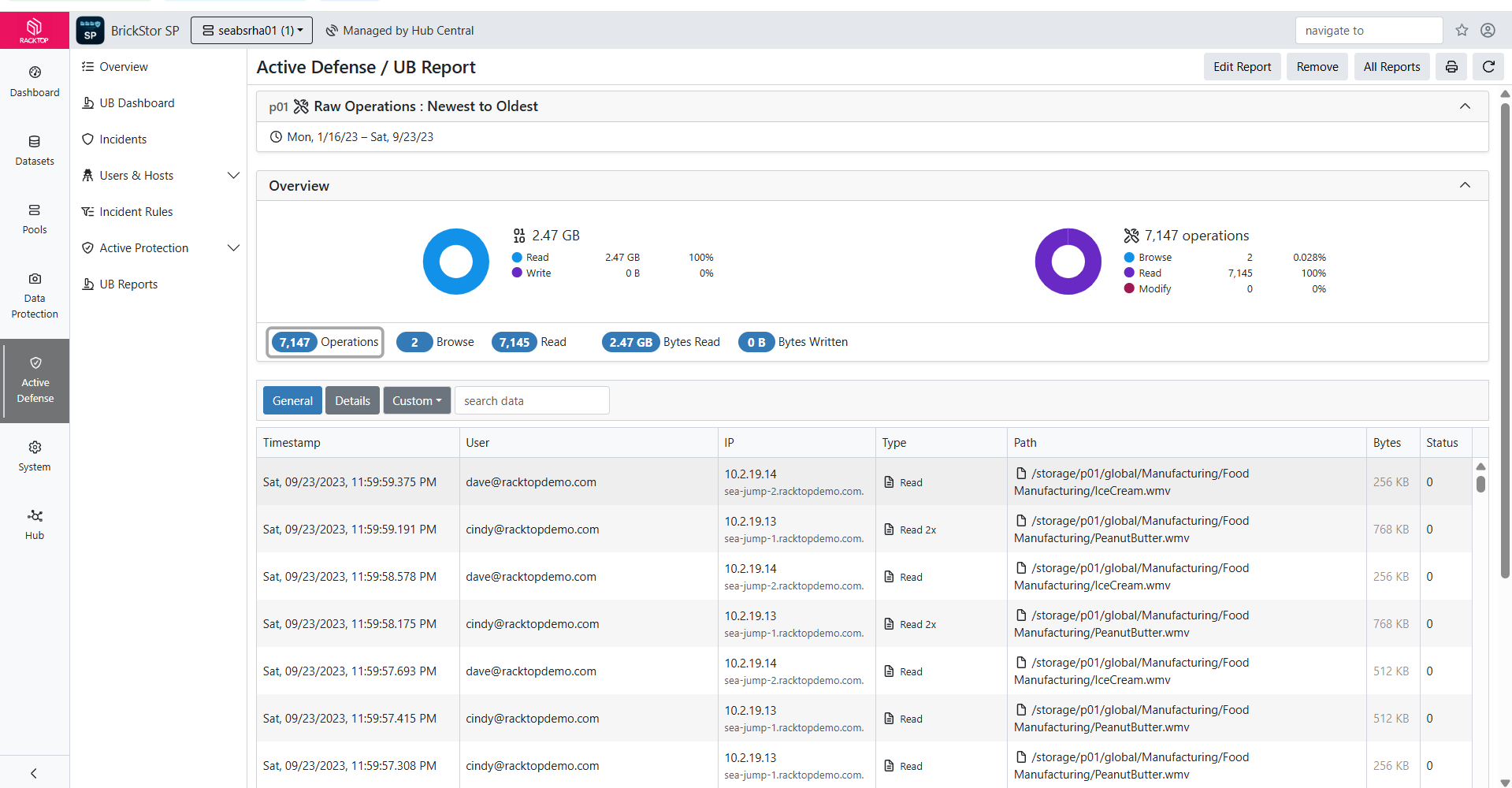
This is the job of User Behavior Auditing. BrickStor SP records every file operation by user, session, and client in an immutable audit trail kept inside the storage operating system, where an intruder cannot switch it off or edit it. When a vulnerability lands, the team reviews the exposure window, October 17 onward in this case, and answers from evidence: did any account read at unusual breadth, reach into shares outside its normal pattern, or connect from a client it has never used? For any account in question, it can list every file that account read before the patch went on. The example UB report below shows what that record looks like.
Active Defense applies the same behavioral view live, which is what NAS ransomware protection has to mean when nobody knows the entry point yet. It needs no CVE number or signature. A session that starts reading or rewriting files in bulk is terminated in under a second, whether it came in through PHP2Shell, a phished password, or next quarter’s flaw. Without that record and that response, a team is left to guess, and guessing tends to end in a worst-case breach disclosure.
Should a storage system run PHP at all?
Synology and QNAP build capable products for what they were designed to do, and both offer snapshots that are worth turning on today. Their design goal is a NAS that also serves media, hosts websites, and runs apps. That breadth is useful at home and in a small office. In an enterprise holding regulated or mission data, every bundled service is one more runtime to patch on someone else’s schedule, and snapshots alone cannot tell you what was read before anything was encrypted.
NetApp’s case shows the problem is not limited to consumer devices. When an enterprise array serves its management interface through PHP, the interim fix for a PHP flaw is to switch that interface off or put another authentication layer in front of it. BrickStor SP does not include PHP, so this week its owners faced no such trade.
There will always be a next CVE: last month it was DSM, this week it is PHP. An enterprise file platform should assume one layer will fail and keep the data safe anyway. Cyberstorage is the practice of building each of the layers below into the storage system that serves the files, so data storage security does not depend on the perimeter holding.
| Layer | The question it answers | How RackTop BrickStor SP addresses it |
|---|---|---|
| Reduced attack surface | Does the storage system also carry a general-purpose web runtime and third-party apps? | A purpose-built storage and security platform rather than an app host, with no PHP, STIG-aligned hardened defaults, and MFA-protected management through Hub Central |
| Least privilege | If one credential is stolen, how much can it reach? | Attribute-based access control (ABAC) evaluated per file and per operation |
| Detection and response | Is someone reading or changing files at a pace no person would? | User Behavior Auditing and Active Defense, terminating hostile sessions in under a second across SMB, NFS, S3, and Web Drive |
| Evidence | Were we exploited before we patched? | An immutable per-operation audit of who touched which file, when, and from where |
| Recovery | Can we restore exactly what changed, even if an admin account is compromised? | Immutable snapshots with a maximum 1-minute recovery point, Intelligent Bulk Remediation (IBR), and the ImmutaVault cybervault |
What to do this week
If you run Synology or QNAP devices, take them off the internet, move remote access behind a VPN, and stop Web Station sites and PHP-based apps you do not need. Apply the vendors’ PHP fixes the day they ship, apply Synology SA-26:13 if you have not, and review logs from October 17 onward for unusual multipart uploads, memory-limit errors, and unexplained HTTP 500 responses. If you run NetApp ONTAP 9, apply one of NetApp’s workarounds until a fixed release ships and watch the advisory for updates. Then rotate any credentials those systems held. If they store business, regulated, or mission data, this is a good moment to ask whether a consumer NAS belongs in that role.
RackTop’s free Cyber Recovery Readiness Assessment is a 32-question scored review of how ready you are to recover from ransomware, insider threats, data theft, and infrastructure compromise. Take it to see which of the layers above you have today, or request a demo to watch Active Defense stop a live ransomware attack on BrickStor SP.
Frequently asked questions
- PHP2Shell is the nickname for CVE-2026-109618 and CVE-2026-109619, two critical vulnerabilities in the PHP core that the PHP project fixed on October 21, 2026, in PHP 8.5.12, 8.4.27, 8.3.36, and 8.2.35. Both are rated CVSS v4.0 9.2 and can allow unauthenticated remote code execution on systems that serve web requests with PHP, including PHP-FPM, Apache with mod_php, and php-cgi. According to Tenable, PHP 7.4 through 8.1 received only minimal source backports, and branches from 5.4 through 7.3 receive no fix.
- Yes, if it serves PHP sites or apps through Web Station, because Synology’s PHP packages were reported to be older than the fixed releases. As of October 22, 2026, Synology had not posted a PHP2Shell advisory. Until updated packages ship, independent guides recommend setting session.upload_progress.enabled to 0 in each Web Station PHP profile, taking Web Station sites offline if they do not need to be public, and keeping DSM off the internet. Separately, apply Synology advisory SA-26:13 from September 18, 2026, which fixed two critical DSM flaws rated CVSS 9.8.
- Yes. QNAP advisory QSA-26-18, published October 22, 2026, lists QTS 5.2.11 and earlier, QTS 6.1.0, QuTS hero h5.2.11 and earlier, h6.0.x, and h6.1.0, QuTScloud c5.2.9 and earlier, and several apps as affected, with fixed versions to be announced. QNAP recommends removing internet exposure, using a VPN, restricting management ports to trusted networks, and stopping PHP-based apps you do not need, and says it has not received reports of exploitation targeting its products.
- Yes, by one of the two flaws. NetApp’s interim advisory NTAP-20261021-0021, last updated October 21, 2026, lists ONTAP 9 as affected by CVE-2026-109618 and not by CVE-2026-109619. NetApp says an unauthenticated attacker could gain access as the www user but would be restricted to the PHP jail. No patched ONTAP release was listed. NetApp’s workarounds are to disable external web services (System Manager, REST, and ZAPI), to enable SAML so authentication is required before PHP runs, or to disable the System Manager and SAML web services alone.
- No. BrickStor SP does not include PHP, so CVE-2026-109618 and CVE-2026-109619 do not apply to the storage platform. That is a design choice: BrickStor SP is a purpose-built storage and security platform, not a NAS that also hosts websites and apps. PHP running on other servers in your environment still needs patching, and if stolen credentials from one of those servers are used against your file shares, User Behavior Auditing and Active Defense in BrickStor SP see and stop that activity.
- No. Setting session.upload_progress.enabled to 0 is an interim measure for CVE-2026-109619 only, and it does nothing for CVE-2026-109618. Tenable and Amazon both say interim settings do not make an installation safe. Updating to PHP 8.5.12, 8.4.27, 8.3.36, or 8.2.35, or to a vendor package built on one of them, is the only complete fix.
- Start from October 17, 2026, the date of the earliest PHP2Shell exploitation attempt reported by Amazon Threat Intelligence. Web server logs may show unusual multipart POST requests, memory-limit errors, or HTTP 500 responses, and QNAP recommends reviewing QuLog Center and running Malware Remover. Those checks cover the PHP layer. To know whether stolen access was used against your files, you need a per-operation record of who read, wrote, and deleted what, from which client. BrickStor SP’s User Behavior Auditing keeps that record immutably inside the storage operating system, so the question can be answered from evidence.
- Patching fixes the vulnerability you know about, after the vendor ships a fix. PHP2Shell drew exploitation attempts four days before disclosure, and a NAS that bundles web apps carries every bundled runtime’s CVEs. Enterprise file data needs layers that hold when one fails: a storage platform that does not double as a web application host, attribute-based access control, behavior-based detection that stops bulk reads and mass encryption, an immutable audit for scoping, and immutable snapshots and a cybervault for recovery.
Sources
Go deeper
More on NAS & file shares
See all →Practitioner Guide
When every storage product claims Cyberstorage: seven tests that tell them apart
September 23, 2026 • 6 min
Threat Brief
Isolation contained the incident. It did not protect the files.
September 2, 2026 • 6 min
Threat Brief
Medusa’s update: the theft was throttled to stay under your thresholds
August 26, 2026 • 6 min